VertigoMe

Your AI Vertigo
Companion

log your spins. it does the rest.

VertigoMe turns the chaos of vertigo into clarity, for BPPV, vestibular migraine, Meniere's, neuritis, PPPD and MdDS. It tracks your sleep, recovery, weather, sodium and wearable data, tests which of them actually go with your spins using real statistics, estimates your risk day by day, and coaches your vestibular exercises by voice.

How it works

log your spins. the rest happens on its own.
1
ConnectData flows in from your wearable, Apple Health or Health Connect, and your phone
2
DetectSleep changes, weather shifts, and stress spikes get flagged automatically
3
ScoreEverything adds up to your daily risk
4
EstimateSee your risk outlook 7 days ahead
5
LearnGets smarter the more you use it
The AI needs about five logged spins before it has anything to say. Every screen can be filled with example data first, so nothing is empty while you get there.
See it in action
Your daily risk gauge, the spin log, wearable sync, automatic triggers, weather, sodium and more. Here's what living with VertigoMe actually looks like.
why track at all?

Dizziness affects 15 to 20% of adults in a year and vestibular vertigo about 5%, and both BPPV and vestibular migraine are largely underdiagnosed.

Neuhauser, Handb Clin Neurol 2016

Estimate your risk
then ask why

today and a 7-day outlook
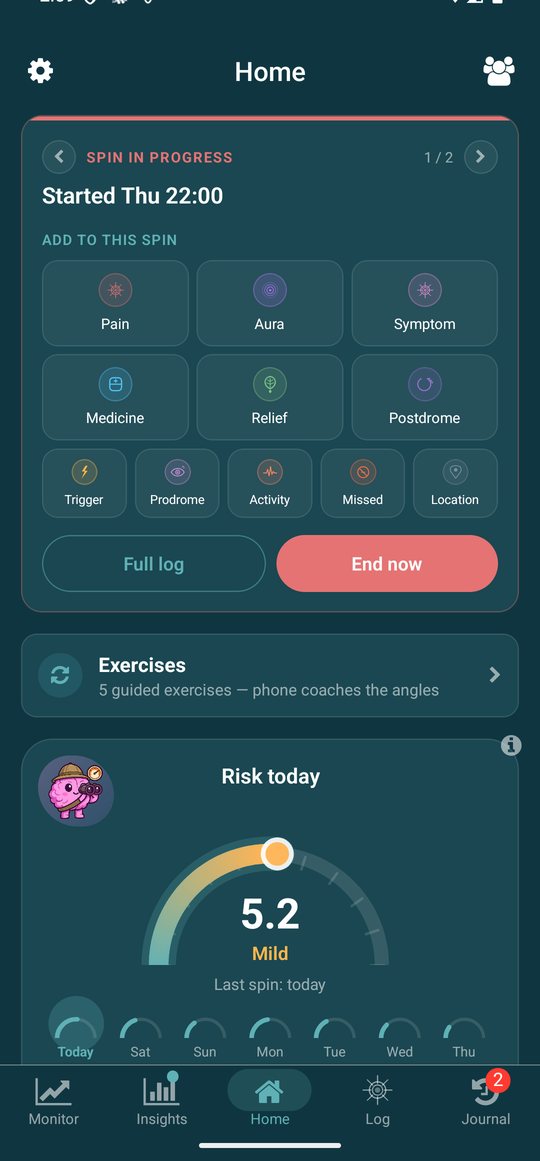
Risk todayOne number in four zones: Negligible, Low, Mild or High, with your top contributors under it. Built from your logged and auto-detected triggers and your warning signs, each fading over a week.
7-day outlookThe week ahead on the same scale, so you can plan around the higher days. The outlook is Premium; the free app shows today.
Ask about your dataAsk VertigoMe reads your own history and answers in plain words. “Was pressure a factor in my last spin?” gets the date, the numbers that day, and whether that pattern has shown up for you before.
why log each spin?

The air-pressure link below was only visible because 56 patients kept a daily vertigo diary for an average of 267 days.

Gürkov et al., PLoS One 2016

Log a spin
in seconds

one tap, fill in later, or say it and it fills itself in
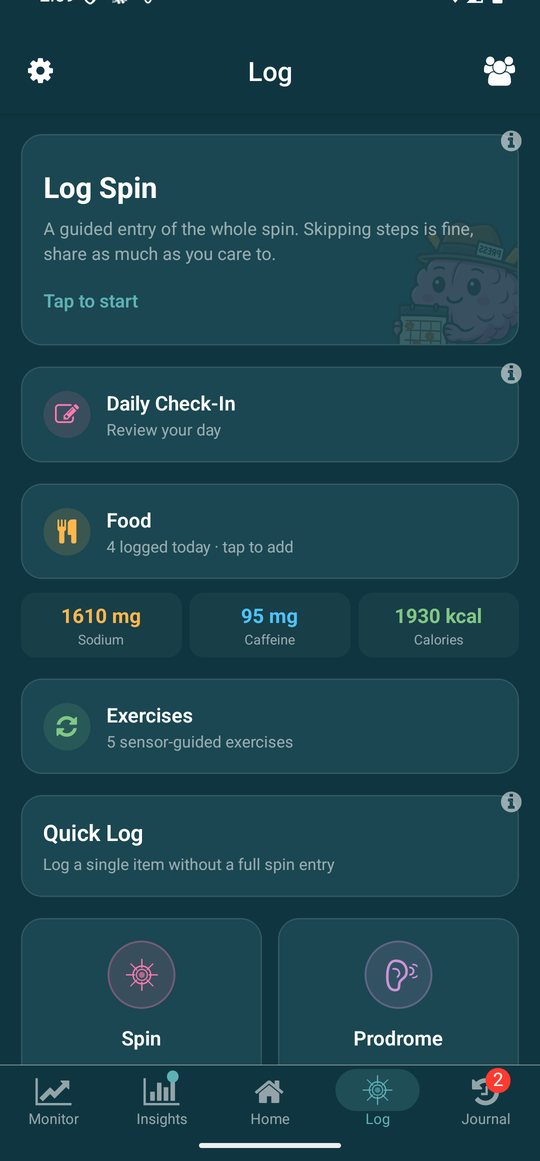
Quick logTap a favourite on the home screen and it is logged with the time: a Spin, a Trigger, a Prodrome, a Medicine or a Relief. Add the detail later, or never.
Active spinOne tap starts a spin with a running timer. Jump straight into a guided Epley, Semont or BBQ roll; it attaches to the same spin. End it when it passes and add the detail whenever you have a moment.
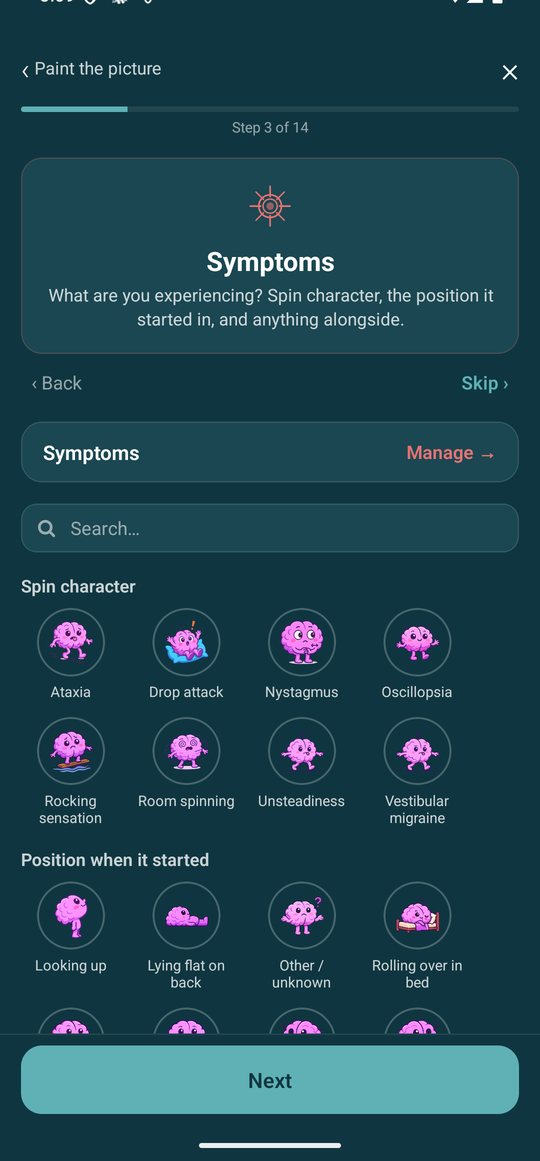
Say itType or speak freely. “Rolled over in bed, room spun, ears felt full, took betahistine.” The app picks out the triggers, symptoms, medicines and reliefs for you to confirm or drop.
why not just guess?

Risk-factor research in vestibular disorders is, in the epidemiologist's own words, only at its beginning. So the app records the candidates instead of assuming them.

Neuhauser, Handb Clin Neurol 2016

Triggers tracked
automatically

sleep, weather, stress, sodium, screen time, and the vestibular ones you log in a tap
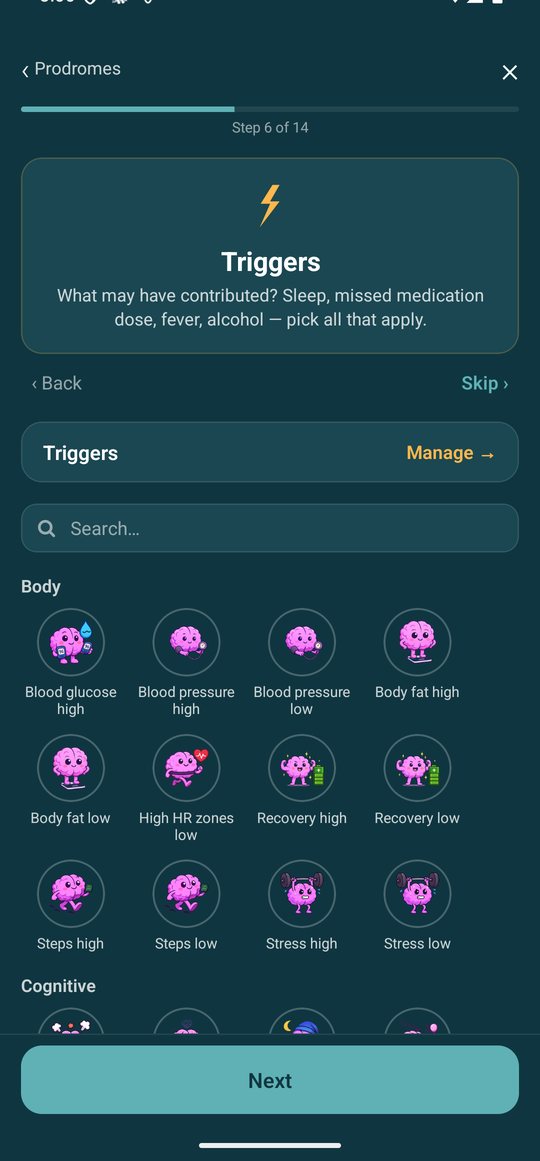
Detected from your dataPressure, humidity, bedtime, sleep stages, stress, recovery, steps, sodium, caffeine, screen time and more, each checked every hour against a threshold and your own 14-day baseline.
The vestibular ones, one tapPosition change, looking up, a sudden head turn, rolling in bed, a car or a boat, visual motion from scrolling or crowds. No sensor can log these, so they are a single tap.
Your own wordsAnything the app does not have, you can add. A custom trigger gets the same statistics as a built-in one.
why your body?

Among 530 people with vestibular migraine, anxiety scores and a history of motion sickness came out as independent factors behind poor sleep.

Pan et al., J Vestib Res 2026

Stress, HRV
and recovery

your body, read every morning from your wearable
Stress indexGarmin and Oura send their own stress score; for other sources the app computes one each morning from HRV and resting heart rate against your 14-day baseline. Stress high and low are automatic triggers.
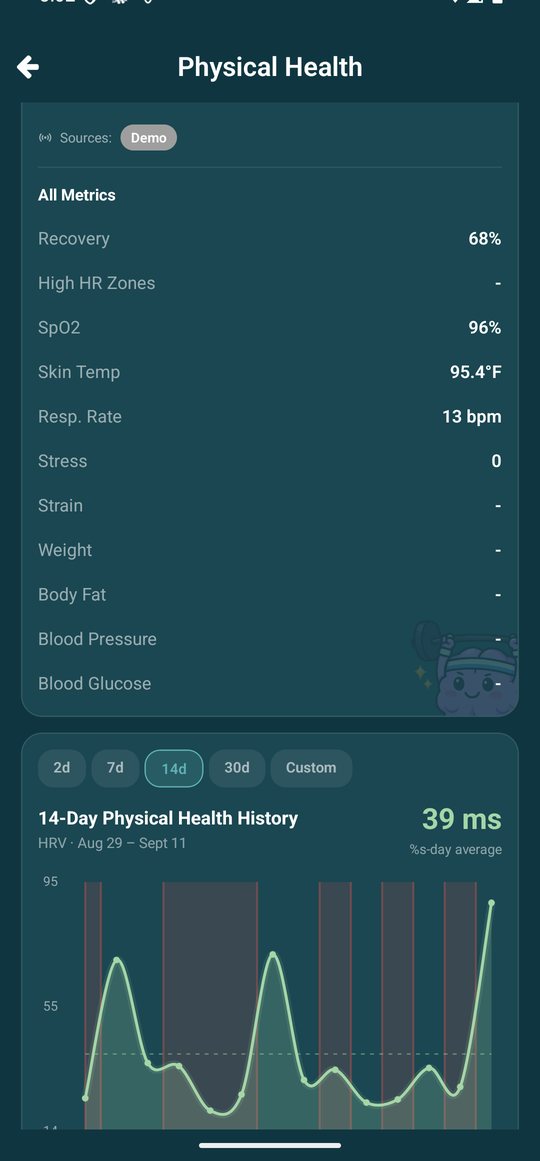
Heart, breathing and skinHeart rate variability and resting heart rate every morning from a connected source, with respiratory rate, SpO2 and skin temperature when your device measures them. All of it is plotted against your spins under Monitor and Physical Health.
Recovery, strain and effortRecovery score and strain where your device provides them, Garmin's Body Battery counting as recovery, plus steps high and low and time in high heart rate zones. Each fires as a trigger when a day crosses your line: a hard session and a day on the sofa both count.
why weather?

Across 56 patients and about nine months of daily diaries, the change in air pressure over the preceding day was significantly associated with the odds of a Ménière episode.

Gürkov et al., PLoS One 2016

Follows the weather
for where you are

pressure, temperature, humidity, UV, storms and altitude, for your city
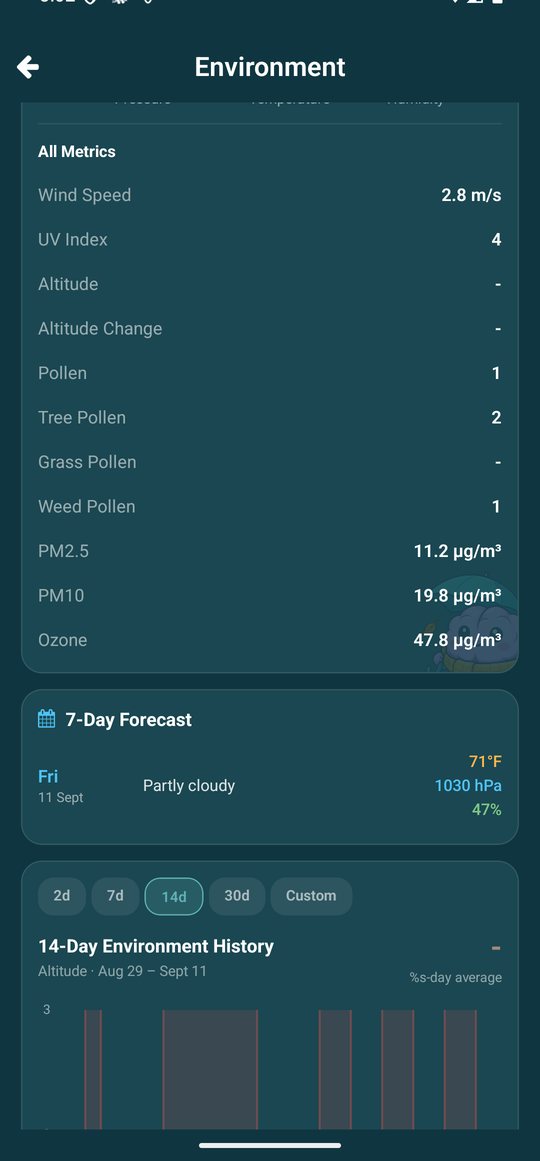
Pressure, and the drop before it landsWhen today's pressure is 10 hPa or more below yesterday's, a card appears on the home screen with the numbers, and a daily check can send a push. The 7-Day Forecast card under Monitor and Environment puts the coming days on screen too, so a drop due on Thursday shows on Monday. The forecast is part of Premium.
Temperature, humidity, wind, UV and stormsEach tracked daily. Pressure, humidity and temperature high and low, and UV index low, are automatic triggers you can weight like any other, and storm days are flagged from the weather code with a warning on the Environment card.
Altitude, travel and your locationAltitude and altitude change come from your location and fire automatically after a change of 500 m or more; travel and jet lag you log yourself. Weather is read from your location at city level only, never your exact address, and stays timezone-accurate when you travel.
why sleep?

Of 530 people with vestibular migraine, 63% scored as poor sleepers, and the worse the sleep score, the worse the dizziness handicap.

Pan et al., J Vestib Res 2026

Tracks your sleep
every night

duration, efficiency, stages and timing
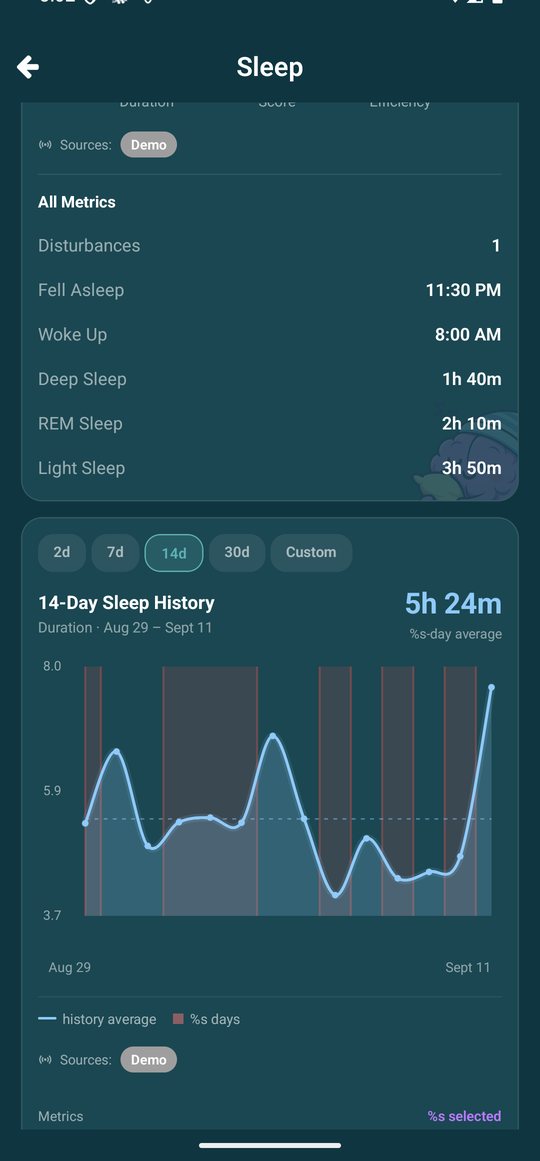
What it records, and from whereDuration, sleep score, efficiency, disturbances, deep, REM and light sleep, time in bed, when you fell asleep and when you woke up. A wearable, Apple Health or Health Connect gives the stages and the score; on Android the phone can estimate your sleep from the longest screen-off gap of the night, and you can also type a night in yourself.
Sleep triggers, automaticBedtime late, wake time early or late, sleep duration high, deep sleep high, REM and light sleep high or low, disturbances high or low. Each fires when your night crosses its line.
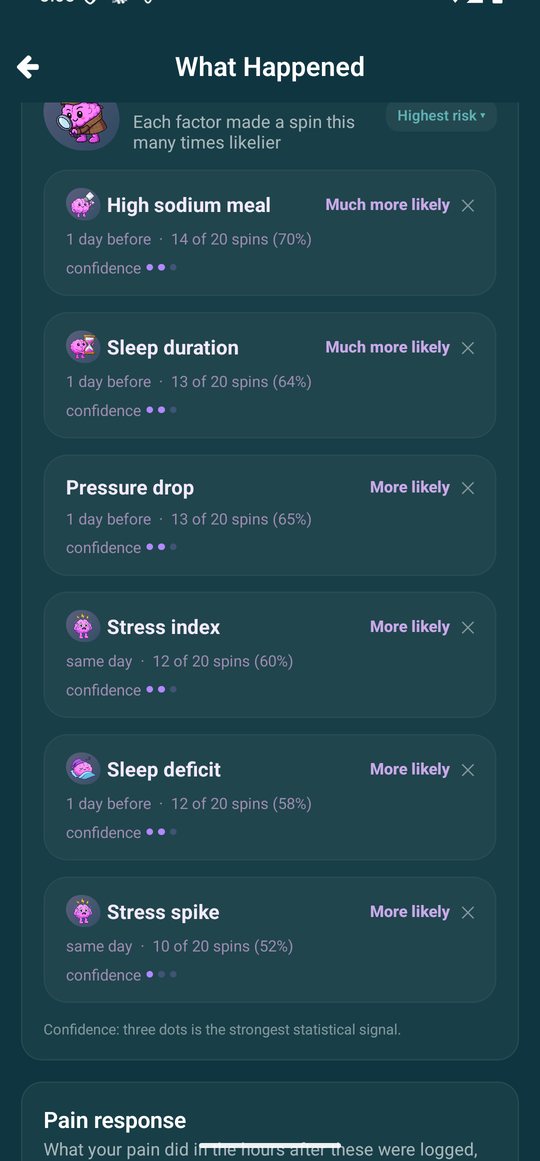
In your score and your patternsA trigger fired from last night raises today's number and its effect fades over the following days, the same as any other. What Happened then tests each sleep signal against your spins and says how much more likely a spin was on those days, in plain words rather than a made-up multiplier, and consistent sleep is one of the habits the app looks for on your spin-free days.
why the exercises?

Pooled across five trials, complete resolution of vertigo rose from 21% on a sham manoeuvre or no treatment to 56% after the Epley manoeuvre.

Hilton & Pinder, Cochrane 2014

Guided vestibular
exercises

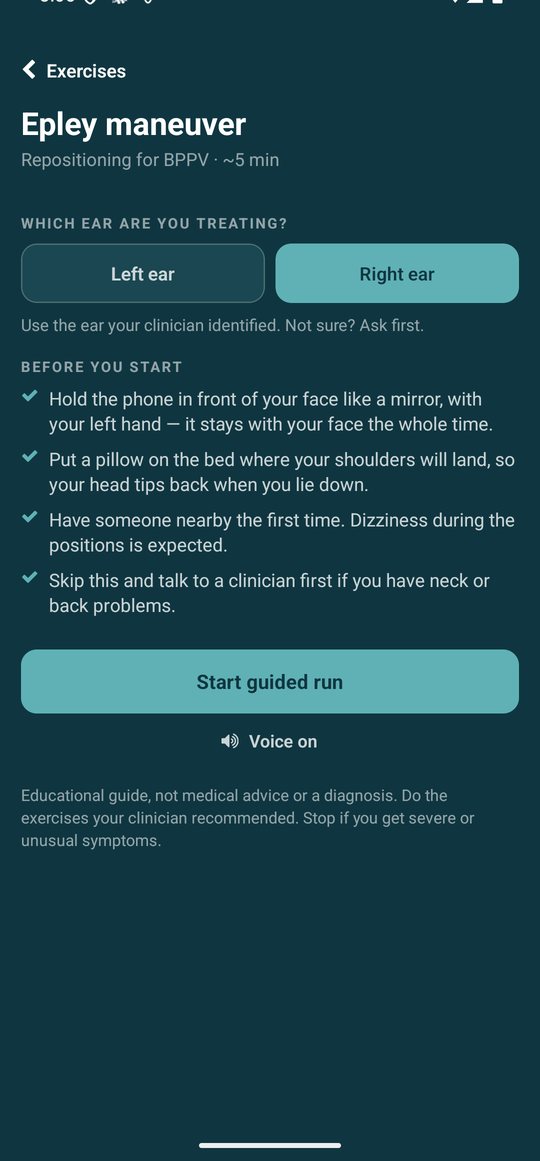
Epley, Semont, BBQ roll, Brandt-Daroff, balance, habituation and gaze, with your phone as the coach
Repositioning, and the home routinesEpley, Semont and the BBQ roll for BPPV, stage by stage, plus the home work: a Brandt-Daroff set, balance retraining where the phone measures your sway, and graded habituation for the movements that set you off. Starting one joins your spin; finishing it is logged as a relief, so Insights can track whether it works for you.
Gaze stabilisation, and a programme that adaptsVOR training in three-minute sessions, with a four-level programme that moves from Getting started to Faster pace, Moving target and Standing as sessions add up, adapting to your last two weeks. Optional camera coaching, nothing recorded, and a local reminder at 08:00, 13:00 or 19:00 if you want one.
Voice, ticks, and a STOP that lands you safelyEvery cue is spoken and felt: one word on screen, big enough to read blurred, MORE, BACK, then the stage word with a countdown, ticks speeding up near the angle and a double-buzz on lock. A full-width STOP ends any exercise, and the safe-landing screen says stay where you are, breathe, sit up slowly when it settles, and lists the symptoms that mean seek help.
why measure salt?

A Cochrane review went looking for placebo-controlled trials of salt or caffeine restriction in Ménière's and found none. The advice is everywhere; the evidence is not.

Webster et al., Cochrane 2023

Counts your sodium
and tags your food

the Meniere's target, and tyramine, histamine, gluten and alcohol
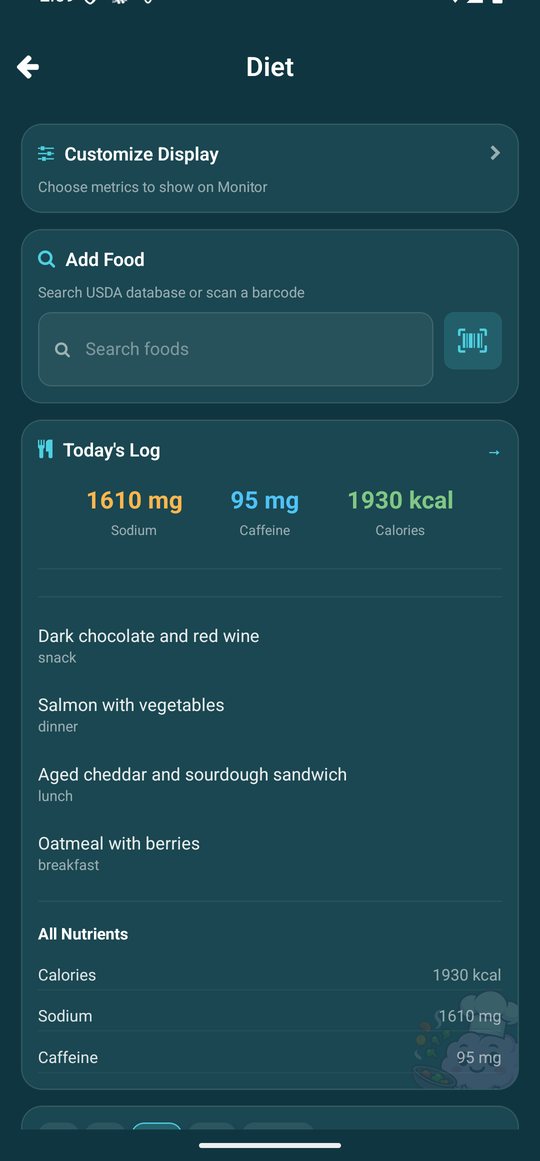
Sodium todayA home card adds up the sodium in what you logged against a 1,500 mg a day target with a 2,000 mg upper limit, and tells you what is left or how far over you are.
Add food in secondsSearch the USDA database or scan a barcode and the food comes back with calories, sodium and its tags. A high-sodium meal is also a one-tap trigger.
Tagged for tyramine, histamine, gluten and alcoholEvery result is marked Low, Medium or High for the four compounds, so a day adds up to tyramine high or histamine high before you have felt anything.
why your own history?

That air-pressure finding came from models that treated each patient as their own baseline rather than comparing one person with another.

Gürkov et al., PLoS One 2016

It finds your
patterns

what happened, what worked, what's helping
What Happened, and the combinationsWhich triggers actually precede your spins, tested against your normal days and stated in plain words: much more likely, more likely, or seen before, always with the honest count. Some things only bite together, so the Patterns page also lists the pairs that multiplied your risk the most.
What Worked, and what's helpingEvery medicine and relief scored on the relief you reported and how often you used it, with the ones used together and the conditions each works best under. Beside it, the habits and steady signals that show up on your spin-free days, measured against your own normal. Nothing here warns or judges.
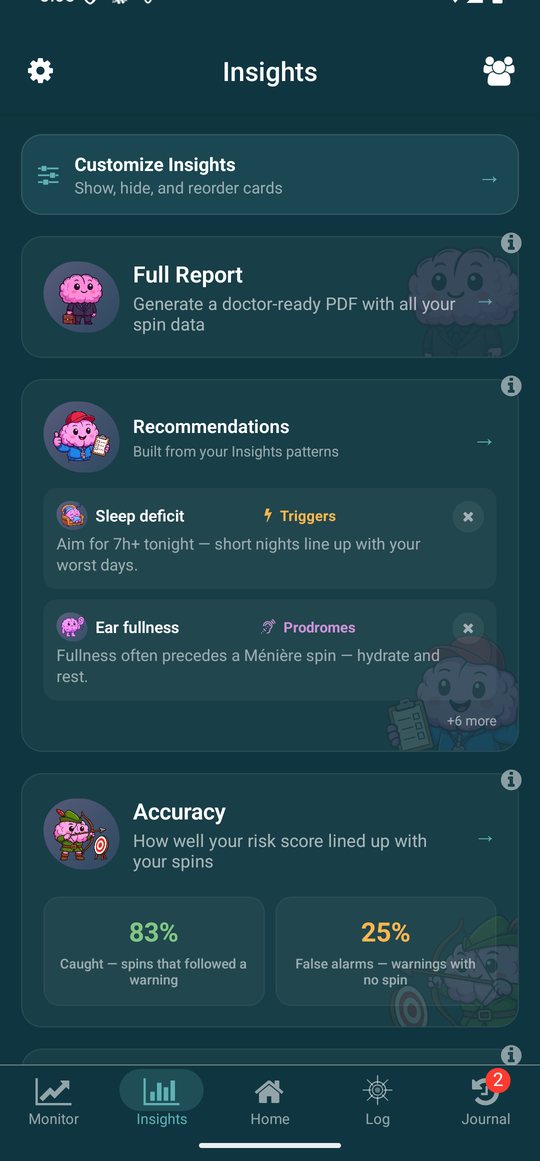
One graph per thing, and what changedRisk, Spins, Medicines, Treatments, Nutrition, Environment, Physical Health, Sleep, Cognitive and Menstruation, each with your spins laid over its history. The last 30 days are set against the 30 before, and an Accuracy card shows how well the risk zones lined up with your actual spins.
why act on it?

Pooled across 39 trials and 2,441 people, vestibular rehabilitation reduced how often dizziness happened compared with no treatment.

McDonnell & Hillier, Cochrane 2015

AI recommendations
a next step for every pattern

built on your own data, not on averages

The AI takes what is already showing up in your data, the items that turn up around your spins, the combinations that look risky together, the treatments that seem to be helping, and adds a personal next step for each one, across five categories.

Triggers and prodromesThe triggers that keep showing up before spins, and the pairs that look risky together, each with a preventive step tied to your pattern. Your personal early signs come with what may be worth doing when they appear.
Medicines, reliefs and exercisesWhat your own usage suggests: what is relieving well, what is not, and what to raise with your doctor. The same angles for non-drug methods, including the guided exercises: timing, alternatives, what to try next.
Activities, and a daily insightHow the timing of exercise, sleep and stress in your logs relates to your spins, and a short VertigoMe Recommendation each day on the home screen, written from your recent data, about what is worth watching today. The daily insight is part of Premium.
Dismiss anything that does not match your reality and it stays hidden for that pattern. Starting points to discuss with your ENT or neurologist, not diagnoses.
why keep adjusting?

In those same trials what improved was the Dizziness Handicap Inventory, a number that only moves if someone keeps measuring it.

McDonnell & Hillier, Cochrane 2015

It learns you
round after round

your model, your severities, checked against your own data
Personal from day oneSetup asks about your spins: how often, how long, which subtypes, warning signs, sleep, diet, weather, stress and what you already suspect. You can tap the mic and talk instead of typing; the app fills in what you tell it and suggests what else is worth tracking. From those answers it builds a model, and every trigger gets a severity you decide: High, Mild, Low or None.
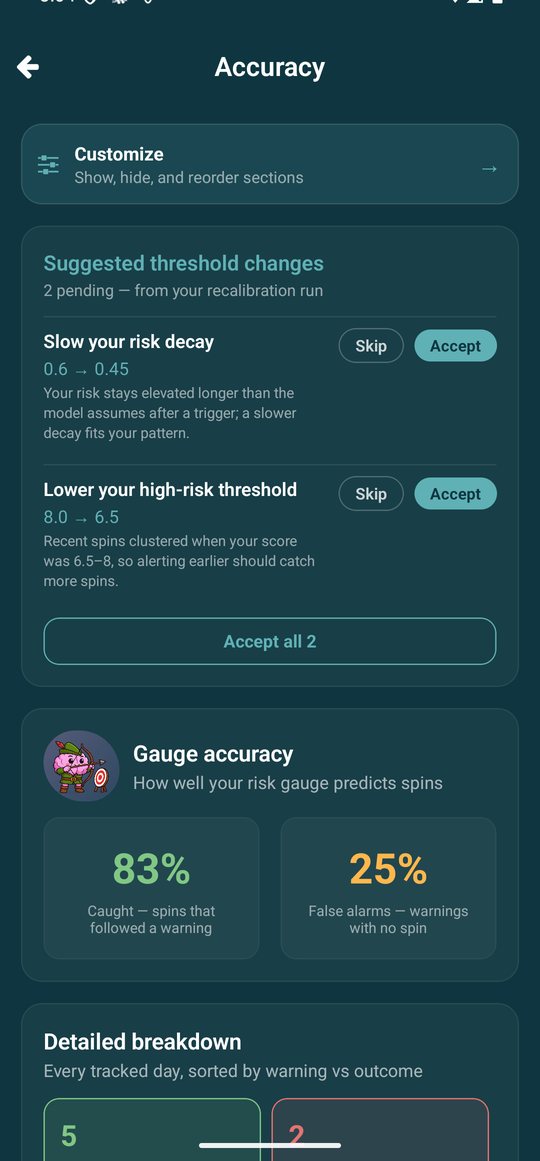
RecalibrationThe app re-reads your spin history, medication log, prodromes and gauge accuracy and suggests changes when something has shifted. Each proposal shows the old and new value and the reason. Accept all, reject all, or pick one by one. Nothing applies until you approve it.
Accuracy you see, control you keepHow well the risk zones lined up with your logged spins, once there are at least seven days of gauge data, so you know whether to trust a high day. Manage Triggers and Risk Model hold the values the app runs on: severities, zone thresholds and decay curves, yours to edit any time, or redo setup from Profile. Everything is measured against your own history, and if a round has nothing to suggest it says so and leaves your settings alone.
why a record?

In 530 patients the handicap score clinicians use tracked with sleep quality and with headache severity: the context is part of the picture, not noise.

Pan et al., J Vestib Res 2026

The full report
and the people around you

your whole story in one document, shared on your terms
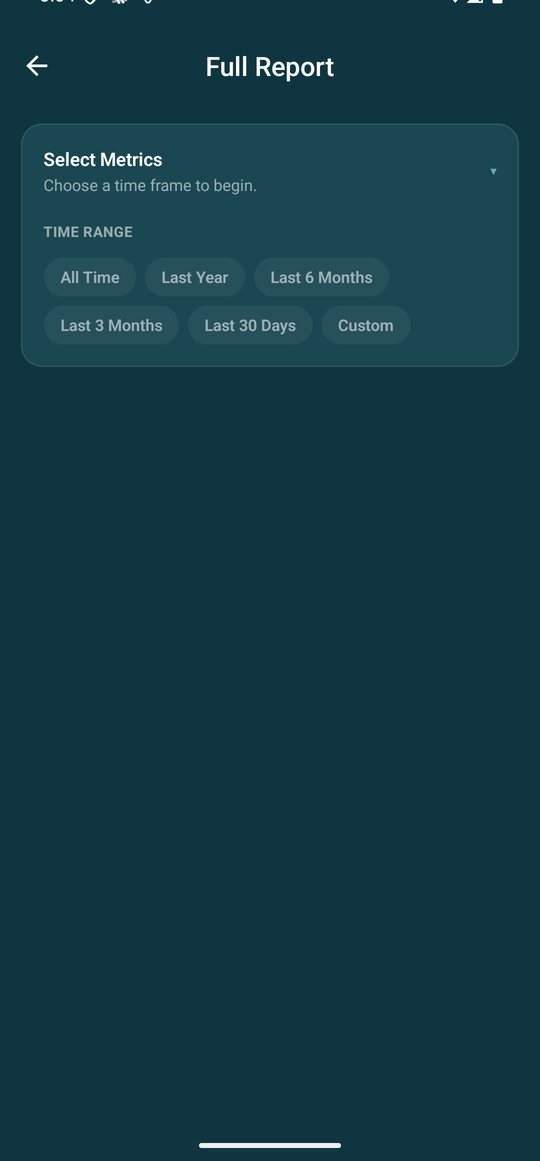
One scrollable report, filtered and exportedFrequency trends, What Happened with the dangerous combinations, treatments and What Worked, What's Helping, activities and locations, severity and symptoms, the timeline, the attack log, spider charts, your DHI scores and your health metrics. Limit it by time range or tag, overlay the metrics you want on the graph, then Generate Report and share the PDF from the share sheet. The PDF is part of Premium.
A caregiver, a practitioner, on your termsInvite a partner, family member or clinician with a link that expires in 14 days: they can see your spins and log what they witnessed, with medicines and triggers only if you switch those on, revocable any time. When a practitioner asks to see your diary you choose what to share, scope by scope, or share nothing; they see nothing until you accept.
Practices near you, and Apple HealthVestibular, balance, ENT, audiology and tinnitus clinics near you, listed from Google, not part of VertigoMe and unable to see your diary. On iPhone your ended spins are also mirrored into Apple Health as Dizziness samples with their severity, and manually logged periods as menstrual flow, so the record lives in your own Health app too.
why hearing?

Ménière's is about ten times less common than BPPV and appears to be over-diagnosed, while vestibular migraine is missed. What your ears do during a spin helps tell them apart.

Neuhauser, Handb Clin Neurol 2016

Hearing changes
and tinnitus

ear fullness, hearing change and tinnitus, logged with the spin
Ear fullness, hearing change and tinnitusEar fullness and hearing change are symptoms in the spin log, one tap each under Accompanying experience, and ear fullness can also be logged as an after-effect. Log Tinnitus or Tinnitus louder and a short sheet asks which ear (left, right or both), what it sounded like (ringing, buzzing, roaring, hissing, pulsating) and how long it lasted.
Warning signs before the spinEar fullness and hearing change are also prodromes, so if they come before the room turns you can log them as your own early signs and the risk model can learn from them.
How often it goes together, and the DHIThe Tinnitus card in Insights shows on what share of your spins you logged tinnitus, which ear, what it sounded like and the average duration. Alongside it, the Dizziness Handicap Inventory: the 25-question clinic score, taken in the app, banded mild, moderate or severe, reminded every one to three months and trended on your report.

And there's
much more

the rest of what it does
Connect your calendarYour events are read on each launch, so a workout counts as an activity and a deadline as a stress trigger. Read-only, with an Undo.
Started a treatment?A drug, a device or a lifestyle change: see your spin days before it started against the weeks on it, in four honest bands.
Track your cycle, if you want toLog your periods and the app predicts the next one and treats the days around it as a trigger. Off unless you turn it on.
Articles and the forumEvidence-based articles and a moderated forum with a me-too tap and AI thread summaries, in the app and at vertigome.com/forum.
Dizziness Handicap InventoryThe 25-question clinic score, taken in the app, trended over time, reminded every one to three months, printed on your PDF.
Demo data firstFill every screen with three months of example data, see what the gauge and insights actually do, then wipe it without touching anything real.

Questions

What is VertigoMe?

A personal vertigo companion for iOS and Android, for BPPV, vestibular migraine, Meniere's disease, vestibular neuritis, PPPD and MdDS. You log your spins; it collects sleep, weather, stress, sodium and wearable data on its own, tests which of them actually go with your spins, estimates your risk day by day, coaches you through vestibular exercises, and turns the patterns into recommendations and a report for your ENT or neurologist.

How does VertigoMe estimate spin risk?

From your triggers. Every trigger you log and every one the app detects, from weather, sleep, your food log, your phone or a wearable, has a severity you chose, and recent ones weigh more than older ones as the effect fades over seven days. Your warning signs, and your cycle if you track it, add to it. The same model gives a 7-day outlook, and recalibration proposes changes for you to accept or reject. It is an estimate from your own history, not a diagnosis.

Which vestibular conditions does VertigoMe support?

All six common subtypes: BPPV, vestibular migraine, Meniere's disease, vestibular neuritis, persistent postural-perceptual dizziness (PPPD) and mal de debarquement syndrome (MdDS). You can pick more than one during setup.

Do I need a wearable?

No. Log your spins and the app works. Weather comes from your location, and on Android the phone can report screen time, noise and even sleep on its own. A wearable, Apple Health or Health Connect adds HRV, resting heart rate, recovery, stress and sleep stages automatically.

Which wearables does VertigoMe support?

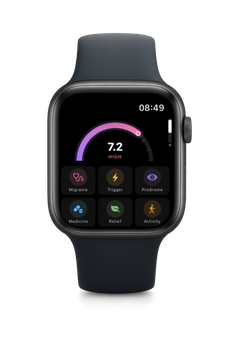
Garmin, Oura and Polar connect directly. Apple Watch and anything else that writes to Apple Health on iPhone or Health Connect on Android comes in from there. There is no VertigoMe watch app; logging happens on the phone.

Are the vestibular exercises a treatment?

No. VertigoMe guides the standard exercises vestibular physiotherapists teach, Epley, Semont, BBQ roll, Brandt-Daroff, balance, habituation and gaze stabilisation, with your phone reading the angle and coaching you by voice. You choose the exercise and the ear your clinician identified; the app never prescribes one, and it says so on the screen.

What is Premium?

The analysis layer: the 7-day outlook instead of just today, the trigger breakdown, the daily insight, Ask VertigoMe, AI recommendations, the treatments monitor, the weather forecast card, the doctor-ready full report PDF and risk model tuning. Logging spins, the guided exercises, automatic tracking and connecting your devices are not behind it.

Is my health data private?

Yes. All health data is encrypted at rest and in transit, VertigoMe is fully GDPR compliant, we never sell your data or share it with advertisers, and you can delete your account and all your spin data at any time. A caregiver or practitioner sees your data only where you consented, and you can revoke it whenever you like.

Is VertigoMe a medical device?

No. It is a personal tracking tool. It surfaces patterns in your own data to help you and your doctor make better decisions; it does not diagnose or treat vertigo.

Start the VertigoMe journey

let's find your balance, together · on iPhone and Android

Your data is yours.

We don't sell your data. We don't share it with advertisers. All health data is encrypted at rest and in transit. VertigoMe is fully GDPR compliant.

Want to leave? Delete your account and every byte goes with you. No questions, no retention, no dark patterns.

VertigoMe

Your inner ear is already talking.
Start listening.

Available on iOS and Android.